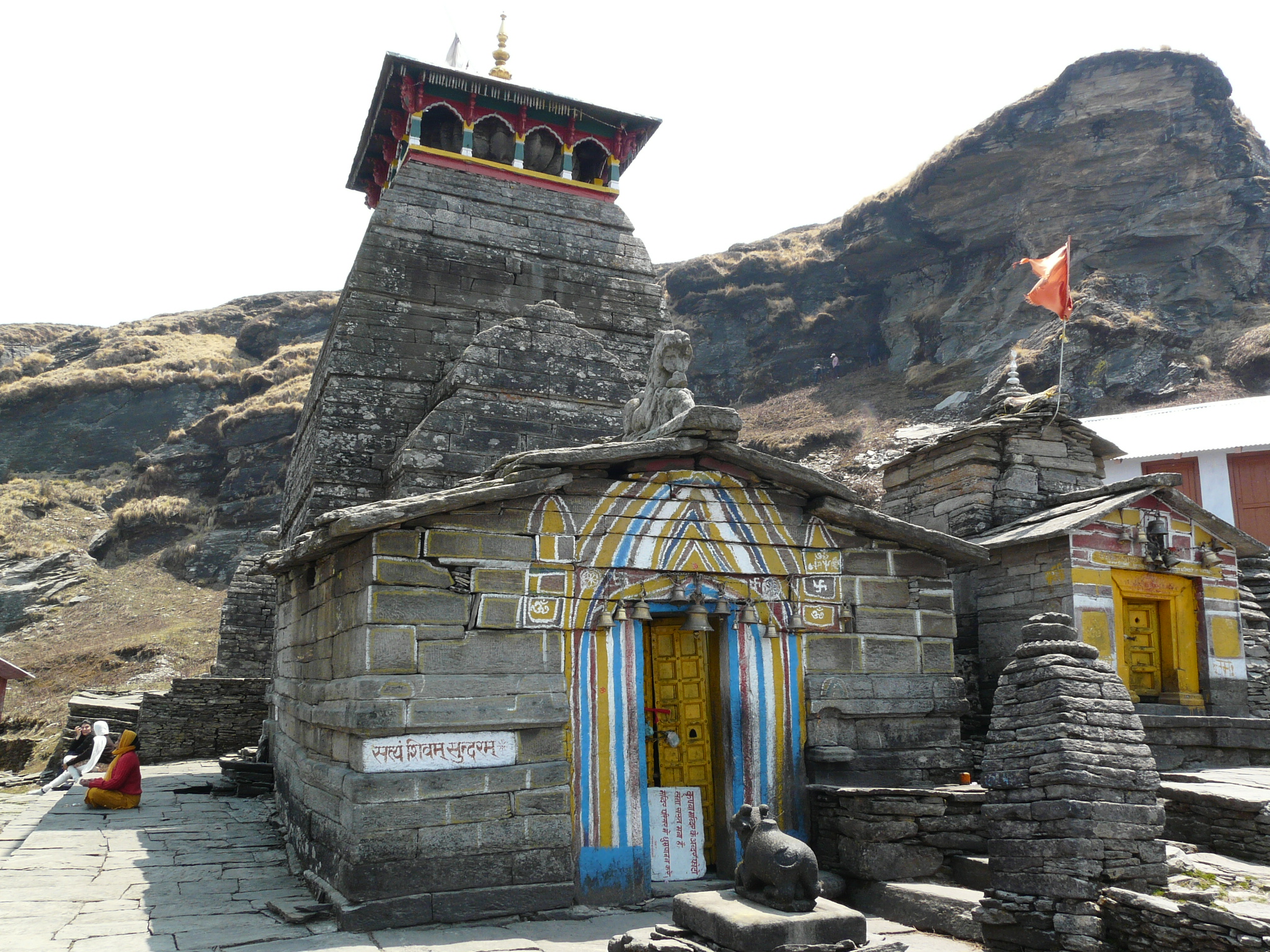
 Tungnath is one of the highest Shiva temples in the world and is the highest of the five Panch Kedar temples located
in the mountain range of Tunganath in Rudraprayag district, in the Indian state of Uttarakhand. The Tunganath (literal meaning: Lord of the peaks)
mountains form the Mandakini and Alaknanda river valleys. It is located at an altitude of 3,680 m (12,073 ft), and just below the peak of Chandrashila
and is the third (Tritiya Kedar) in the pecking of the Panch Kedars. It has a rich legend linked to the Pandavas, heroes of the Mahabharata epic.
According to Hindu mythology, Lord Shiva and his consort, Parvati both reside in the Himalayas: Lord Shiva resides at Mount Kailash.
Parvati is also called Shail Putri, which means 'daughter of hills '.The Tunganath is indelibly linked to the origin of the Panch Kedar temples built
by the Pandavas. The legend states that sage Vyas Rishi advised the Pandavas that since they were culpable of slaying their own relatives (Kauravas,
their cousins) during the Kurukshetra war, their act could be pardoned only by Lord Shiva. ...
Consequently, the Pandavas went in search of Shiva who was avoiding them since he was convinced of the guilt of Pandavas. In order to keep away from them,
Shiva took the form of a bull and went into hiding in an underground safe haven at Guptakashi, where Pandavas chased him. Later, Shiva's body in the form
of bull's body parts rematerialized at five different locations that represent the Panch Kedar. The Pandavas built temples at each of these locations to
worship and venerate Lord Shiva, seeking his pardonand blessings. Each temple is identified with a part of the bull or Shiva's body; Tungnath is identified
as the place where the bahu (hands) were seen;hump was seen at Kedarnath; head appeared at Rudranath; his navel and stomach surfaced at Madhyamaheshwar;
and his jata (hair or locks) at Kalpeshwar.
Tungnath is one of the highest Shiva temples in the world and is the highest of the five Panch Kedar temples located
in the mountain range of Tunganath in Rudraprayag district, in the Indian state of Uttarakhand. The Tunganath (literal meaning: Lord of the peaks)
mountains form the Mandakini and Alaknanda river valleys. It is located at an altitude of 3,680 m (12,073 ft), and just below the peak of Chandrashila
and is the third (Tritiya Kedar) in the pecking of the Panch Kedars. It has a rich legend linked to the Pandavas, heroes of the Mahabharata epic.
According to Hindu mythology, Lord Shiva and his consort, Parvati both reside in the Himalayas: Lord Shiva resides at Mount Kailash.
Parvati is also called Shail Putri, which means 'daughter of hills '.The Tunganath is indelibly linked to the origin of the Panch Kedar temples built
by the Pandavas. The legend states that sage Vyas Rishi advised the Pandavas that since they were culpable of slaying their own relatives (Kauravas,
their cousins) during the Kurukshetra war, their act could be pardoned only by Lord Shiva. ...
Consequently, the Pandavas went in search of Shiva who was avoiding them since he was convinced of the guilt of Pandavas. In order to keep away from them,
Shiva took the form of a bull and went into hiding in an underground safe haven at Guptakashi, where Pandavas chased him. Later, Shiva's body in the form
of bull's body parts rematerialized at five different locations that represent the Panch Kedar. The Pandavas built temples at each of these locations to
worship and venerate Lord Shiva, seeking his pardonand blessings. Each temple is identified with a part of the bull or Shiva's body; Tungnath is identified
as the place where the bahu (hands) were seen;hump was seen at Kedarnath; head appeared at Rudranath; his navel and stomach surfaced at Madhyamaheshwar;
and his jata (hair or locks) at Kalpeshwar.
 Kartik Swami temple is located near Kanak Chauri village on
Rudraprayag Pokhari route in the Rudraprayag district of
Uttarakhand. A mild 3k trek from Kanak Chauri village takes
you to the stunning beauty of Kartik Swami temple.
Kartik Swami temple is dedicated to the elder son of Lord
Shiva, Kartikeya, who offered his bones as testimony of his
devotion to his father. It is believed that the incident took
place here. Lord Kartik Swami is also known as Kartik Murugan
Swami in the southern part of India.
A constant sound from hundreds of bell hung in the temple can
be heard at a distance of about 800 metres from there. A flight
of 80 stairs from the main road leads you to the garbhagriha of
the temple or the place where the idol is kept.
Sandhya Aarti or evening prayers, enchantment of mantras and
Maha-bhandara or grand feast organised at the temple occasionally
is a special attraction for devotees and tourists.
...
Kartik Swami temple is located near Kanak Chauri village on
Rudraprayag Pokhari route in the Rudraprayag district of
Uttarakhand. A mild 3k trek from Kanak Chauri village takes
you to the stunning beauty of Kartik Swami temple.
Kartik Swami temple is dedicated to the elder son of Lord
Shiva, Kartikeya, who offered his bones as testimony of his
devotion to his father. It is believed that the incident took
place here. Lord Kartik Swami is also known as Kartik Murugan
Swami in the southern part of India.
A constant sound from hundreds of bell hung in the temple can
be heard at a distance of about 800 metres from there. A flight
of 80 stairs from the main road leads you to the garbhagriha of
the temple or the place where the idol is kept.
Sandhya Aarti or evening prayers, enchantment of mantras and
Maha-bhandara or grand feast organised at the temple occasionally
is a special attraction for devotees and tourists.
...
According to Hindu mythology, Lord Shiva (the destroyer) told his
sons Ganesha and Kartikeya that one of them, who will be the first
to take seven rounds of the universe will have the privilege of being worshiped first.
Ganesha took seven rounds around Shiva and Parvati, while Kartikeya
faithfully circled the universe. Impressed by Ganesha, Shiva gave
him the honour of being worshipped before anyone. Angered by this,
Kartikeya sacrificed his body and gave his bones to Lord Shiva as reverence.
Consequently, the Pandavas went in search of Shiva who was avoiding them since he was convinced of the guilt of Pandavas. In order to keep away from them,
Shiva took the form of a bull and went into hiding in an underground safe haven at Guptakashi, where Pandavas chased him. Later, Shiva's body in the form
of bull's body parts rematerialized at five different locations that represent the Panch Kedar. The Pandavas built temples at each of these locations to
worship and venerate Lord Shiva, seeking his pardonand blessings. Each temple is identified with a part of the bull or Shiva's body; Tungnath is identified
as the place where the bahu (hands) were seen;hump was seen at Kedarnath; head appeared at Rudranath; his navel and stomach surfaced at Madhyamaheshwar;
and his jata (hair or locks) at Kalpeshwar.
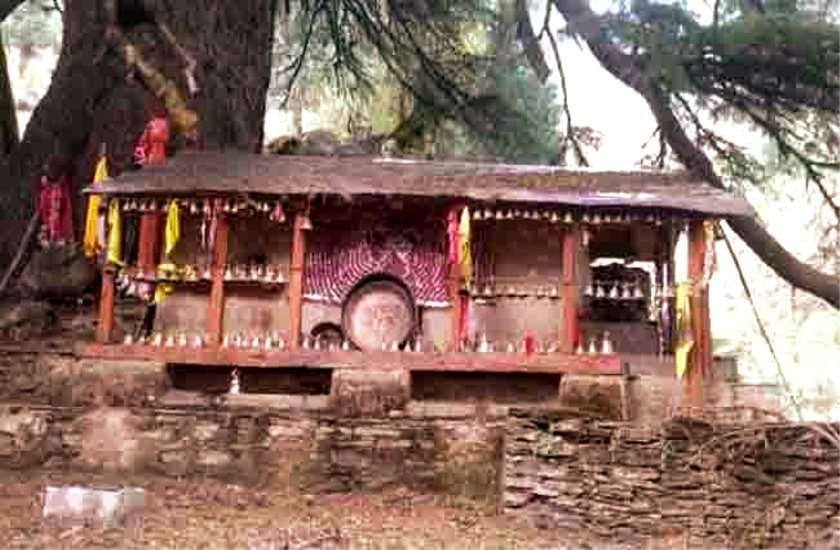 Actually people of this region believe that this temple is home to a huge snake.
The door of this temple opens only once a year on Baisakh Purnima. Only
one person dares to enter the sanctum sanctorum inside the temple and that
is the priest of the temple. The amazing thing is that the priests also enter the temple
in a special way due to fear of that serpent god.
Actually people of this region believe that this temple is home to a huge snake.
The door of this temple opens only once a year on Baisakh Purnima. Only
one person dares to enter the sanctum sanctorum inside the temple and that
is the priest of the temple. The amazing thing is that the priests also enter the temple
in a special way due to fear of that serpent god.
It is said that Latu Devta is kept captive in this temple. They are not
allowed to leave the temple. Goddess Parvatik, better known in the region
by Nanda Devi, is the coudsin of the god Latu.
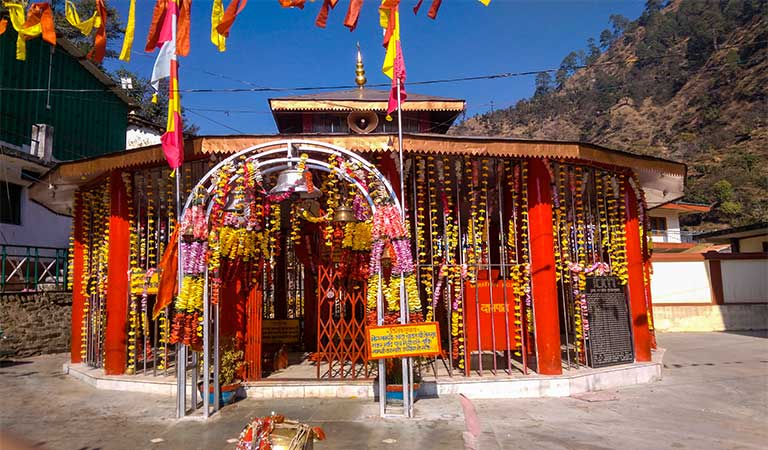 It lies at an altitude of around 6,000 feet (1,800 m) on the
Saraswati river in the Himalayas, surrounded by the peaks of
Kedarnath. Kalimath is situated close to Ukhimath and Guptakashi.
It is one of the Siddha Peeths of the region and is held in
high religious esteem.
It lies at an altitude of around 6,000 feet (1,800 m) on the
Saraswati river in the Himalayas, surrounded by the peaks of
Kedarnath. Kalimath is situated close to Ukhimath and Guptakashi.
It is one of the Siddha Peeths of the region and is held in
high religious esteem.
The temple of Goddess Kali there is visited by devotees year round, especially during the Navratras.
This holy shrine is one of 108 Shakti Peethas in India as per Srimad Devi Bhagwat.
The upper part of Kali is worshipped in Dhari Devi. The remaining part in Kalimath religious tradition
is that Kalimath is where Kali killed the demon Raktavija and went under the earth. Kalimath is the only'
place where the goddess Kali is worshipped along with her sisters Laxmi and Saraswati.
No idol is worshipped in the temple. Instead the Sri Yantra is the object of devotion....
On one day each year the goddess is taken out and Puja is performed at midnight, with
only the chief priest present.Near the temple are other ancient temples to Laxmi, Saraswati,
Gauri Shankar and many antique Shivlings, idols of Nandi and Ganesh, etc.
An eternal holy flame always burns in the temple of Laxmi. Bhairava Mandir is located nearby.
Barti Baba is credited for preserving the sanctity of this holy shrine. All the people who met
him and the locals say that he had a direct connection with Maa Kali.
The guru and Member of Parliament, Satpal Maharaj, set up a small Dharamshala near the temple where pilgrims can stay.
About 2 km east is Kunjethi village, hosting two temples of Mata Manana Devi and Mankameshwar Mahadev.
6 km from Kalimath at the top of a hill there is a huge Kalishila and another one Kali Temple.
Barkha Giri Baba and Sarawati Mai lived there in a hut for many years.